
Hello, I have a question. Recently, I’ve seen many companies mentioning VDI. What exactly is it?

VDI stands for Virtual Desktop Infrastructure.
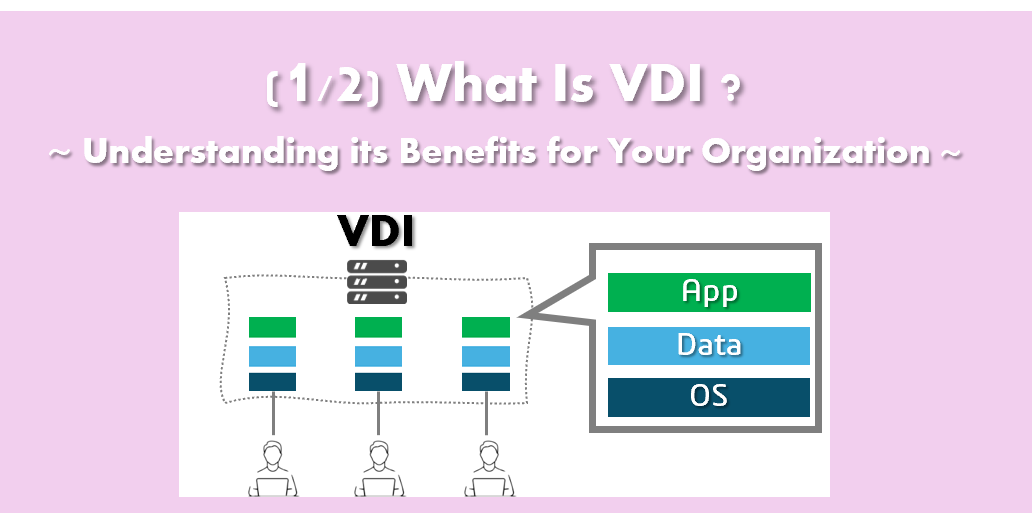
Simply put, it means your company’s entire PC environment is hosted on a server rather than on your physical device.
Your operating system and applications run on the server, and you can access your virtual desktop remotely from various devices, such as PCs and tablets.
I see.
And can VDI handle heavy workloads like 3D design CAD, CAE or CAM?
Absolutely. VDI can support graphics-intensive workloads such as 3D CAD, CAE, and CAM. For demanding 3D applications, GPUs can be used on the server side to provide the required graphics and computing performance.
Your laptop simply displays the output and sends commands back to the server, while the server handles the actual computation.
Then, what does a VDI environment look like?
[VDI Structure]:
- Hypervisor
- A Hypervisor is software that creates and manages virtual environments on a Host Server (Physical Server), enabling multiple Virtual Machines (VMs) to run simultaneously and independently.
- Commonly used hypervisors include VMware vSphere/ESXi, Citrix Hypervisor, Microsoft Hyper-V, and Nutanix AHV. In the architecture shown in the diagram, VMware ESXi 8 is referenced.
2. Physical Server
- The Host Server is a physical server running a hypervisor such as VMware ESXi. The server is designed with high-performance specifications such as high-performance CPUs, large-capacity RAM, Disk, and GPU, as shown in the Hardware section of the diagram. This Host Server is responsible for creating and running Virtual Desktops (Windows VDA) for users to access remotely.
3. GPU Virtualization (For heavy workloads)
- For advanced design and engineering workloads that require high performance, such as CAD (3D Design), CAM, CAE (Simulation/Analysis), Rendering, and Visualization, NVIDIA vGPU technology enables a single physical GPU to be shared efficiently among multiple virtual machines, allowing users to access GPU-accelerated applications in a virtual desktop environment.
- NVIDIA vGPU (NVIDIA GRID) enables a single GPU to be efficiently shared among multiple Virtual Machines, with license management handled through the NVIDIA GRID License Server in the Management layer.
- Each CAD user is provided with high-performance GPU resources, as if they had a dedicated graphics card on their own machine, allowing them to run real-time simulations, high-resolution rendering, and AI-assisted design smoothly.
- This technology enables engineering innovation to advance further, such as Generative Design, Digital Twin, and real-time environmental analysis, without the need to invest in multiple high-end workstation-class graphics machines.
4. Storage Server
- Operating system data, applications, user files, and Virtual Machines are stored on centralized storage such as SAN, NAS, or vSAN.
- Because data is centrally managed, organizations can simplify backup, recovery, and data management.
5. Connection Broker
- The Connection Broker manages user authentication and access, connects users to the appropriate virtual desktops, and manages sessions and policies.
6. User Device
- Users can access VDI from a variety of devices, including laptops, Thin Clients, Zero Clients, and tablets. Most of the processing is performed on the server side, while the user device simply provides access to the virtual desktop.

Is it safe to access VDI from home? What about data security?
Yes. When properly designed and managed, VDI can enhance security.
With VDI :
- Data stays off local devices, reducing the risk of data exposure if a device is lost or stolen.
- USB access and file transfers can be controlled to help prevent unauthorized data sharing.
- User access and activity can be monitored through centralized management and logging.
Together, these capabilities help provide enterprise-level security and support a more secure way of working remotely.
VDI helps organizations work securely from anywhere.

That’s good.
And I’ve seen a small box connected to a monitor—what is that?
That device is called a Thin Client or sometimes a Zero Client.
It connects to a monitor, keyboard, and mouse and serves as a lightweight endpoint for accessing the virtual desktop. Most of the processing is performed on the server side.
So, is a Thin Client mandatory for using VDI?
Not at all! You can use a laptop or any regular PC. Just install a client application or log in via a web browser.
Companies may choose Thin Clients because they are easier to manage, can improve security, have a longer service life, and require less maintenance.
I understand.
Is VDI only for large organizations?
Not at all. VDI can be an effective option for organizations of different sizes, depending on their needs and environment.
Large enterprises — VDI can help centralize IT management and security. Software updates and security policies can be managed centrally without physically accessing each device.
Small and medium businesses — VDI can provide flexible remote access. Employees can work from home, while traveling, or from multiple office locations and access the same desktop anywhere.
And if we actually want to use it, would the cost be high?
Since they mentioned servers, it sounds like it might be quite expensive.”
There can be initial investment for servers and hardware. But in the long run, VDI is often more cost-effective because:
- You don’t need to buy expensive workstations for every employee
- Thin Clients (low-cost) can replace traditional PCs
- Lower maintenance and repair costs
- Centralized updates reduce IT workload
- Longer device lifecycles can reduce replacement costs
Overall, VDI can help optimize IT costs over the long term.
VDI (Virtual Desktop Infrastructure) is not as complex as it sounds. It is a modern approach that helps organizations.
✔ Work securely from anywhere
✔ Simplify IT operations
✔ Reduce long-term hardware costs
✔ Improve data security
VDI is a powerful step toward centralized IT management.
Thank you. We will consider it.
Contact us.